
Plastic Freight Containers as a Reliable Solution for Modern Logistics
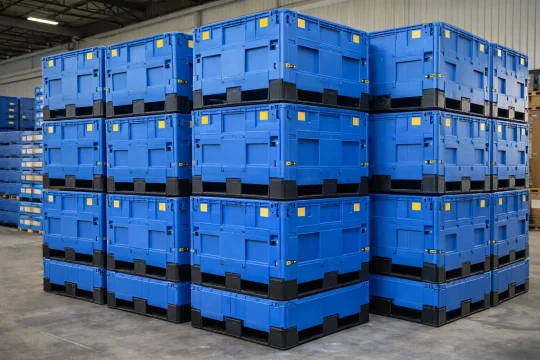
Plastic freight containers play a vital role in modern logistics as companies demand safer, cleaner, and more efficient transport solutions. As global supply chains expand, businesses must handle goods with containers that ensure protection while supporting operational efficiency. Plastic freight containers meet these requirements by offering durability, versatility, and consistent performance. Consequently, many industries now rely on them to streamline freight handling and reduce operational risks. Continue reading to explore how these containers support logistics systems across various sectors.
Read Also MSP Plastic Pallets
Understanding Plastic Freight Containers
Plastic freight containers are reusable transport units designed to carry goods safely throughout supply chains. Manufacturers typically use high-density plastics to ensure strength and resistance to impact. These containers support repeated handling during loading, storage, and distribution without compromising structural integrity.
Unlike traditional materials, plastic containers offer consistent dimensions and smooth surfaces. This consistency improves compatibility with automated systems and material-handling equipment. As a result, warehouses and distribution centers achieve better efficiency and workflow organization.
To appreciate their value further, it is important to examine how different industries apply plastic freight containers in daily operations.
Industries That Use Plastic Freight Containers
Many industries require secure and hygienic transport solutions. Plastic freight containers address these needs by providing reliable protection and easy handling. Their adaptability allows use across multiple sectors with varying requirements.
These support manufacturing, food processing, pharmaceuticals, automotive, and retail logistics. Each industry benefits from their durability and standardized design. This versatility explains their widespread adoption in global supply chains.
Manufacturing and Industrial Logistics
Manufacturing operations involve frequent movement of components between production stages. Plastic containers simplify this process by offering stackable and pallet-compatible designs. Workers can transport parts efficiently while maintaining organization.
In industrial environments, plastic freight containers improve inventory visibility and reduce product damage. Their robust construction supports heavy loads and repetitive use. These advantages help manufacturers maintain consistent production schedules.
Food and Pharmaceutical Distribution
Food and pharmaceutical industries prioritize hygiene and compliance. Plastic containers feature non-porous surfaces that support thorough cleaning. This characteristic helps maintain strict sanitation standards.
In temperature-controlled logistics, plastic freight containers perform well within cold storage environments. Their stable structure protects goods during transport and storage. As a result, companies preserve product quality throughout distribution cycles.
Advantages of Plastic Freight Containers
The growing preference for plastic containers results from their operational benefits. Businesses that adopt them often experience improved efficiency and lower long-term costs.
One major advantage involves durability. Plastic freight containers resist moisture, corrosion, and impact damage. This resistance extends their service life compared to alternatives.
Another advantage relates to standardization. Uniform container sizes support efficient stacking and space optimization. Warehouses store more goods within limited space while maintaining accessibility.
Cost Efficiency and Reusability
Cost efficiency remains a key consideration in logistics. Reusable plastic containers reduce reliance on disposable packaging. Over time, businesses lower packaging expenses and waste management costs.
Plastic freight containers also support sustainable logistics strategies. Many containers use recyclable materials. By reusing containers over multiple cycles, companies reduce environmental impact while maintaining operational performance.
Design Features That Improve Performance
Effective container design enhances safety and usability. Manufacturers integrate features that support modern logistics requirements. These features improve handling efficiency and protect transported goods.
Foldable or collapsible designs allow empty containers to occupy less space during return transport. This feature reduces reverse logistics costs. Ergonomic handholds also improve manual handling safety.
With modular construction, plastic freight containers integrate easily with automated storage and retrieval systems. This compatibility supports warehouse automation and future expansion.
Load Stability and Safety
Load stability remains critical in freight transport. Reinforced walls and secure stacking mechanisms prevent container movement during transit. Stable stacking protects goods and reduces accident risks.
By using them, companies enhance workplace safety. Reduced product damage also improves customer satisfaction and operational reliability.
Role in Global Supply Chains
Global logistics requires containers that perform consistently across long transport routes. Plastic freight containers meet international shipping standards while supporting efficient handling.
Standardized dimensions simplify container loading and unloading across transport modes. As a result, logistics providers coordinate shipments more effectively. This consistency improves inventory accuracy and traceability.
In international operations, plastic freight containers support uniform handling procedures across distribution centers. Standardization reduces training complexity and operational errors.
Choosing the Right Plastic Freight Containers
Selecting suitable containers requires careful evaluation of logistics needs. Load capacity, container size, and material quality influence performance. Businesses should also assess compatibility with existing equipment.
Customization options add further value. Labeling, color coding, and RFID integration support advanced tracking and inventory control. With proper selection, plastic freight containers become a strategic asset rather than a simple transport tool.
Conclusion
Plastic freight containers provide a dependable and efficient solution for modern logistics challenges. Their durability, reusability, and standardized design support safe transport and optimized storage across industries. From manufacturing to global distribution, these containers strengthen supply chain performance. By investing in the right plastic freight containers, businesses enhance efficiency, safety, and sustainability in an increasingly competitive logistics environment.
Email: info@msplastics.co.id
Tel: +62811160199

